

Attack On Saudi Leaves OPEC With 940,000 Spare Reserve
The report stated that Nigeria’s capacity to benefit from the shortfall was limited by production instability.
 Smoke is seen following a fire at Aramco facility in the eastern city of Abqaiq, Saudi Arabia, September 14, 2019REUTERS/STRINGER
The attack on oil facilities in Saudi Arabia has left the Organisation of Petroleum Exporting countries (OPEC), with just 940,000 barrels per day of the extra reserve to meet demand, Reuters reports.
The report stated that Nigeria’s capacity to benefit from the shortfall was limited by production instability.
Although it did not give a specific figure on the extent of the output limitations, Reuters said, ‘Nigerian exports have also suffered from disruptions.’ Nigeria’s pipelines are constantly subjected to breaches and ruptures. These disruptions lead to shot-ins on production. The most recent pipeline leak reported in the media was on the Abura oil field in Delta State on August 29.
“Three key crude oil conveyors, the Trans Ramos pipeline, the Nembe Creek Trunkline and the Trans Forcados pipeline, all leaked crude at different times in 2018 and 2019. These pipelines carry about 400,000 barrels of petroleum per day. Besides oil spills, there is also the problem of theft.”
Godwin Obaseki, the Edo State governor, had just at the time of the Abura spill, said the country lost 22 million barrels of oil per day in six months.
It was estimated that the attack which the US is accusing already sanctioned Iran of carrying out, took out 5.7m bpd of crude oil.
“According to data from the International Energy Agency, OPEC had a ‘global supply cushion’ of about 3.21m bpd. Saudi Arabia is said to have 2.27m of that petroleum, which has now been taken out by the drone attack claimed by the Houthi rebels but attributed to Iran by the US government.
The attack caused a 15-percent surge in the price of the commodity, which is good news for Nigeria’s oil-dependent economy.
At 3:22 am Monday, Brent crude – the benchmark used to price Nigerian grades, reportedly opened at $66.45 and reached a high of $71.95 per barrel.
The commodity went for around $62 per barrel on Friday.
TIMELINE

John Payne@john_payne7
Higher oil prices could push global inflation close to 5% @OxfordEconomics

11:10 AM – Sep 16, 2019 Twitter Ads info and privacy
Updated at 6.49pm BST
Warning bells, akin to those used to alert fog-bound mariners steering towards rocks, have been ringing out for months.
They have mostly been ignored. The daunting bill for multiple acts of political insouciance, measured in lives and petrodollars, is now coming due.
The world ignored the warning signs – and now the Middle East is on the brink

Updated at 6.26pm BST
Full story: Saudi attack sends oil spiking
The Saudi oil attacks have triggered the steepest petroleum market price surge in 30 years and stoked fears for the global economy.
The attacks on Saudi Arabia’s oil infrastructure led to the biggest jump in global prices since 1988 by wiping out 5.7m barrels of production a day – 5% of the world’s oil supply.
The price of Brent crude surged by more than $12 (£9.60) a barrel within seconds as trading began in London, quickly breaching the $70 a barrel mark.
The energy price shock reverberated through global markets, driving up shares in energy companies on the prospect of higher profits, while stock exchanges across Europe plunged into the red as investors took fright over rising geopolitical tensions.
Oil market analysts claim prices could surge towards $100 a barrel in the coming weeks if Middle East tensions reignite disruption in the strait of Hormuz, a key transit route for the world’s oil tankers.
A Middle East energy crisis could be a boon for US shale producers, but threatens to tip the stumbling global economy into a major recession by stemming supply to Asian economies.
Donald Trump said the US was “locked and loaded” to retaliate and could authorise the release of US oil reserves to help balance the market. But energy experts cast doubt on whether US fracking companies would be able to fill the gap left by Saudi oil production plants.
Bjørnar Tonhaugen, the head of oil markets at Rystad Energy, said the world was “not even close” to being able to replace Saudi exports.

Richard Partington
 @RJPartington
Saudi oil attacks push prices up by highest amount since 1988 – raising fears over the impact on the world economy https://www.theguardian.com/business/2019/sep/16/saudi-oil-attack-prices-up-brent-crude …

Saudi oil attacks push prices up by highest amount since 1988
Price of Brent crude surges by more than $12 a barrel as 5% of world’s oil supply is wiped out
theguardian.com
2:34 PM – Sep 16, 2019 Twitter Ads info and privacy
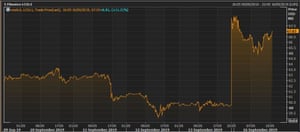
Fiona Cincotta, senior market analyst at City Index, says traders are focusing on how quickly supply can return to normal at the Saudi Aramco plant.
Geopolitical risk in the Middle East is nothing new. However, what we are seeing is a physical disruption to supply, as the attacks over the weekend cut half the county’s oil production. This equates to a disruption on as much as 5% of global oil production.
We can expect oil prices to remain elevated whilst production is disrupted, some reports suggest that this could be weeks. As supply returns, we can expect the price of oil to start declining back towards $62, should geopolitical risks ease as well. However, with the US “locked and loaded” awaiting signs from Saudi Arabia that Iran was involved, tensions in the middle east could get worse before they get better. Under these circumstances the price of oil could remain elevated for some time yet.

