

A lot has been said about the importance of investing in girls and ensuring that they are not left behind. A question which has been coming up is what is the return on this investment. We will serialise amazing stories showing the great impact investing in girls will have on our communities, countries, and the world at large.
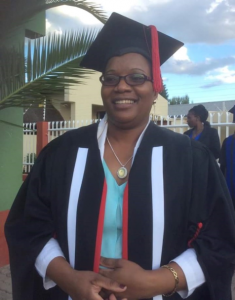 Nailoke Pauline Kadhila – Scientist
Ms. Nailoke Pauline Kadhila is a scientist. She joined the Southern Africa Network for Biosciences (SANBio) in 2009 as the Assistant Node Coordinator for mushroom project and is now the coordinator of the SANBio Mushroom Node which is hosted by the University of Namibia. She started her career as an Agronomist but later developed great interest in Mycology, Microbiology and Molecular biology. Her main interest is in Mycology, mostly on Basidiomycetes.
Pauline holds an MSc in Applied Biology from the University of Namibia and a Bachelor of Science (BSc) from Zhejiang University People’s Republic of China. She is currently working towards a PhD degree, focusing on Namibian indigenous mushrooms – especially those of medicinal importance. The main project she is busy with is the possibility to domesticate the Termitomyces mushroom species which are a delicacy in Namibia, if not in the whole Southern African Region.
“I have been involved in researching indigenous Ganoderma mushrooms which I and my colleagues managed to domesticate and study their mycochemical profile and nutritional contents compared to other Ganoderma species found elsewhere in the world. We then managed to develop Ganoderma Dietary Supplements in the form of capsules that can be used to boost the immune system and ward off many ailments. We also harvest and buy local edible mushrooms and process them into soups that can be kept longer and used off-season, since these mushrooms are only available during the rainy season”.
Through cultivation and post-harvest trainings offered by the Mushroom Node the community members are able to grow mushrooms for their own consumption and as a cash crop. After training, communities are able to create jobs by employing other community members to grow mushrooms or as sales people for mushroom products, e.g. soups and teas.
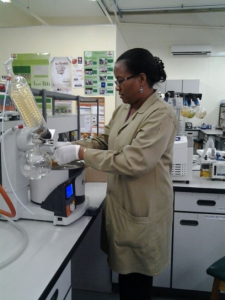 Pauline believes that female scientists should always believe in themselves and have confidence in what they do while being open to criticism because that is what will make them better scientists. “Ask when necessary, even if it is asking the junior person next to you. Lastly, pursue your dream to the fullest. It is better to love and enjoy what you do as a scientist than what you make out of it. Everything that a woman does, she does it with love and passion. Because of that, most women are successful scientists and have contributed greatly to science. Most recent discoveries are a result of research by women, as reported in media. However, we must strive for more woman representation in science,” says Pauline.
She states that while no particular person inspired her to become a scientist, she has always dreamed of wearing the white lab coat: “Now that I am having it on daily, I am gratified and I will not waver.” When she is not in the laboratory or green house she spends time cooking for her family or friends, reading or debating something with her sons.
Do you have a great idea about how we can get more women and girls to realise their dreams? We want to hear from you. Write to the Make Girls Count Competition.
{loadposition user99}

